mBracelet
How might a wearable computer become an interface between people, rather than between a person and a machine?
This question motivated the design of mbracelet, a wearable computing prototype developed for NCR’s Knowledge Lab at a time when wearable technologies were still largely imagined as miniature computers attached to the body. Rather than treating the wearable as a more efficient personal device, mbracelet proposed a different role for technology. It explored how computation could facilitate social interaction, creating opportunities for encounter, exchange, and shared experience instead of simply delivering information to an individual user.
The project emerged from the observation that personal technologies increasingly mediate everyday relationships. As mobile devices moved from desktops into pockets, bags, and onto bodies, they were no longer simply tools — they became participants in how people communicate, perform identity, and inhabit social space. Designing these technologies therefore required thinking beyond usability and functionality towards the ways they shape human relationships.
Technology should not become more personal. It should become more social.
This led to the concept of social functionality: the idea that digital devices should not only support interaction between people and machines, but actively enable interaction between people. Technology becomes meaningful not when it demands attention, but when it creates conditions for conversation, collaboration, play, and serendipitous encounters.
Rather than beginning with available technologies, the project began by studying existing social behaviours. Working with teenage users, I examined how friendships were formed and maintained through the exchange of objects, gestures, messages, and rituals of belonging. These observations became the foundation for the design itself.
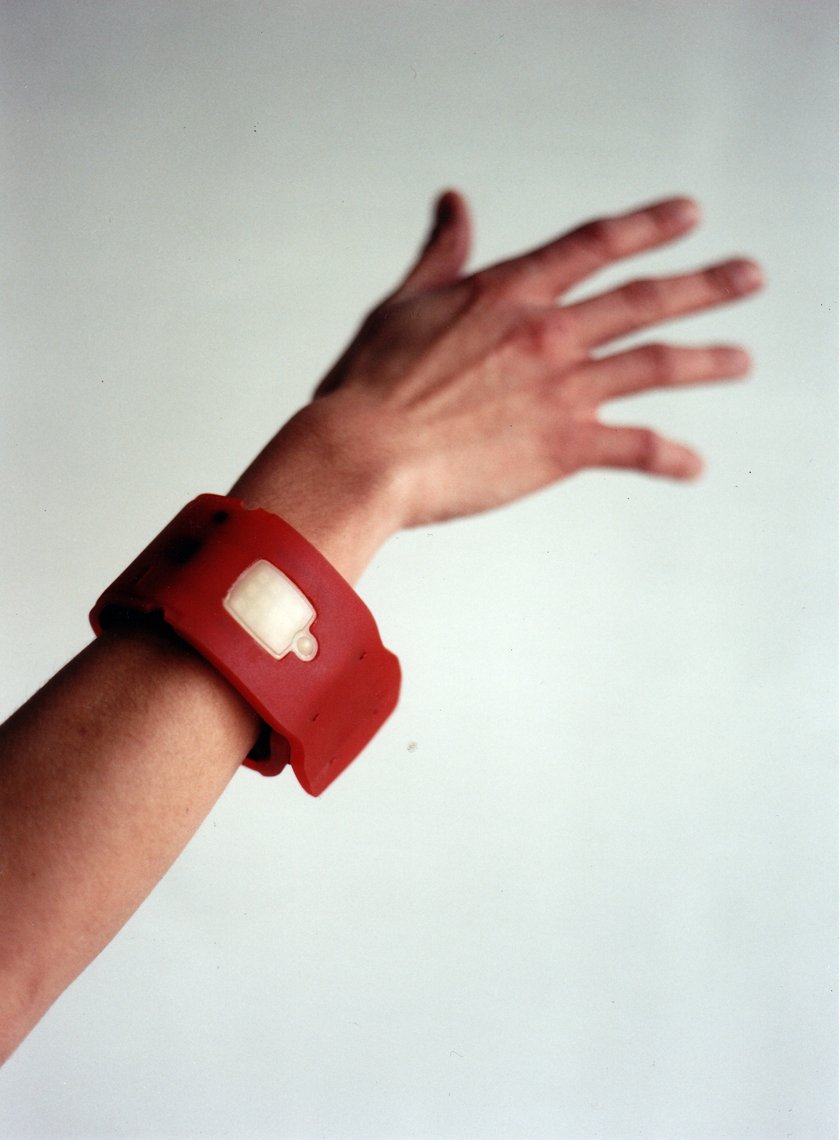
The resulting wearable functioned as a modular digital platform. Interchangeable components let users customise what they carried, while physical exchanges between wearers enabled information to be shared through embodied gestures rather than invisible wireless transactions. A cross-handshake interaction transformed the familiar act of greeting into a means of exchanging digital messages, collapsing the distinction between physical and virtual communication. Programmable light patterns let users express identity dynamically through movement, turning the device into an evolving medium of self-expression rather than a static object of personalisation.
Equally important was the material design of the wearable itself. Flexible circuitry, waterproof polyurethane, conductive fastenings, and modular architecture were developed to make computation feel inseparable from the experience of wearing jewellery or clothing. The interface was designed to disappear into everyday life, allowing social interaction — not technology — to remain at the centre of attention.
Interfaces that communicate through touch rather than screens; digital systems that support intimacy rather than efficiency.
Looking back, mbracelet represents the beginning of an ongoing investigation that continues throughout my practice. Many of the questions first explored here reappear in later projects, including LoveJackets, Vambrace Conversations, and all my work in The Unruliness of Matter: how interfaces can communicate through touch rather than screens; how digital systems can support intimacy rather than efficiency; how materials themselves can become conversational; and how technology might strengthen human relationships instead of replacing them.
Although developed long before today’s conversations around embodied AI, affective computing, and wearable intelligence, mbracelet proposed a simple proposition that continues to guide my work: technology should not become more personal. It should become more social.
← All work