Despina Papadopoulos
I build systems that think through matter.
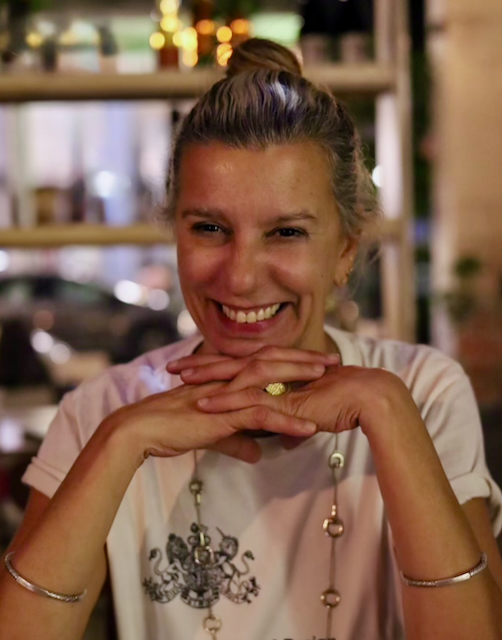
Photo by Lola Serrano
My work asks how intelligence, meaning, and connections emerge through bodies, materials, technologies, and institutions. Rather than treating design as the production of objects, I use it as a mode of philosophical inquiry: building wearable technologies, archives, performances, and computational systems that investigate how we come to know, behave, and engage with one another.
Over three decades I have worked across research labs, industry, universities, and cultural institutions — researching connected devices and wearable systems at Interval Research and NCR’s Knowledge Lab; leading information-experience design at IBM’s Innovation Center; as VP of Product Innovation at Empathic Technologies, directing a team across neuroscience, psychology, design, and machine learning to build affective and haptic technologies; and rebuilding a dispersed national archive as a living topology that resists its own closure. The work holds five patents, has been exhibited at the Victoria & Albert Museum, the Gwangju Design Biennale, and the Holon Design Museum, and grows from training in philosophy (Leuven), interaction design (NYU ITP), and a practice-led PhD at the Royal College of Art. While the contexts vary, the questions remain remarkably consistent: How do systems shape behaviour? What forms of intelligence do they privilege? How might they be designed differently?
Today my work focuses on embodied AI, material computation, and the ethics of intelligent systems — carrying two decades of teaching design and technology ethics at NYU and the RCA into current research. I am interested in forms of intelligence that emerge through interaction rather than abstraction, through material constraints rather than optimisation, and through care, ambiguity, and reciprocity rather than prediction alone.
Intelligence that emerges through care, ambiguity, and reciprocity — rather than prediction alone.
I am co-author, with Caterina Moruzzi, of Material Encounters: Creativity in the Times of AI (Oxford University Press, forthcoming).
Across research, teaching, and practice, I build what I think of as philosophy machines: systems that do not simply demonstrate ideas, but generate new ways of thinking.
I work with organisations, research institutions, and interdisciplinary teams on the conceptual and practical challenges of emerging technologies. My practice brings together philosophical inquiry, design research, and technological development, with a focus on embodied AI, affective systems, wearables, and the evolving relationships between humans, machines, and materials.
Five questions that run through my work:
- Intimacy as a technological condition — how technologies mediate desire, connection, vulnerability, and relationships.
- Care as a design principle — how systems might support reciprocity, attention, and interdependence rather than extraction and optimisation.
- Affect as relational and embodied — how feelings, sensations, and responses emerge between bodies, environments, materials, and machines.
- Materiality as intelligence — how materials participate in thinking, making, and the emergence of new forms of knowledge.
- Ethics as practice — how values, agency, and responsibility are embedded in the systems we design and build.
Available for strategic advisory, research collaborations, talks, and workshops.
Get in touch: despina@philosophymachines.com
"Thank you for teaching us to enjoy the uncertainty of life!"
So starts a thank you email from one of my undergraduate students that I never got to meet in person, as the entire class was conducted online in the middle of the COVID pandemic. I treasure this email and feel proud and honoured that I was able to impart this message.
As an educator, I encourage my students to be keen observers, to think about the ideologies of the tools they use, to create their own tools when possible, and importantly, help them articulate who they are and who they want to be. Criticality, ultimately, coupled with care and intention, is what my teaching philosophy is.