Material Encounters
Material Encounters: Creativity in the Times of AI is a book I am writing with the philosopher Caterina Moruzzi, under contract with Oxford University Press. It asks how creativity is conceived, practised, and mediated through the technologies of making — from the hand in the clay to the model in the machine.
The wager of the book is that creativity is not a property of minds but an emergent, relational process between minds, materials, and machines. To test it, we did not only write — we convened. Over two days in Athens, Caterina and I brought together nine makers with deep material expertise — ceramicists, weavers, architects, digital artists, coders — and asked them to work through, and with, the question of how creativity is made.
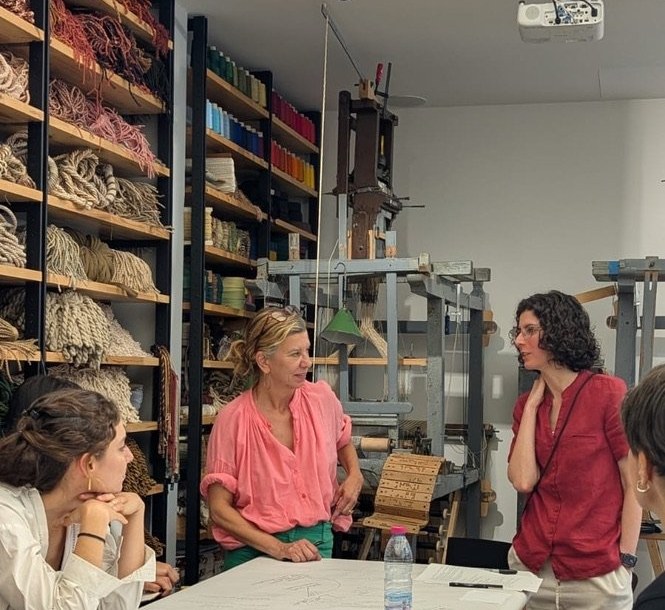
The structure was deliberate. We began by mapping the book’s concepts — technē, intentionality, process, desire, materiality — onto each maker’s own practice. Then each showed us the moments when a material resists, surprises, or guides them: the tacit knowledge of learning to read a material’s affordances and its limits. On the second day we forced an exchange — a ceramicist wrote code, a digital artist worked clay, a weaver explored algorithmic pattern — to defamiliarise skill and surface everyone’s assumptions about control and creative agency. We were working in the lineage of Jane Bennett’s vibrant matter and Karen Barad’s insistence that matter matters, listening for what Adorno would call constellations of meaning.
AI receded to the background — just another technology of making.
Something unexpected happened. We had planned for AI to be central; over two days it receded and became just another technology of making — even as we all knew it is claiming a larger piece of the equation. We were surrounded by Jacquard looms from the 1800s and still-operating machines enmeshed with their operators, unable to run without their idiosyncrasies — their quirks, and maybe their quarks — being tended. What bonded the room was not technology but desire: the wish to share the delight, and the pain, of the creative process with peers who were there out of love for what they do.
I have spent this year thinking about love and about creativity, and it was a double-take to realise how much the two share — desire, care, tending, listening, giving time, memory, narrative. That is what the book is building towards: that creativity, like love, is a relational and material process that cannot be reduced to efficiency or output, and that AI enters this field not as its author but as one more technology through which technē makes us as we make it.
Technē makes us, as we make technē.
The workshop — The Making of Creativity — was supported by the Edinburgh College of Art RKEI Fund, BRAID UK, the AHRC, the Onassis Foundation, and Doric Shipbrokers S.A., and hosted at the NHMA / Benaki Museum in Athens; participants were invited to join the “Creativity, AI, and the Human” cluster at the Edinburgh Futures Institute. Full documentation, with experimental work by Kevin Walker, lives at the-making-of-creativity.com.
← All work