Day-for-Night
Day-for-Night — an homage to Paco Rabanne and a celebration of the beauty of electronics — is a modular, reconfigurable dress comprised of 448 white circuit boards, though the number changes, as the dress can grow longer or shorter.
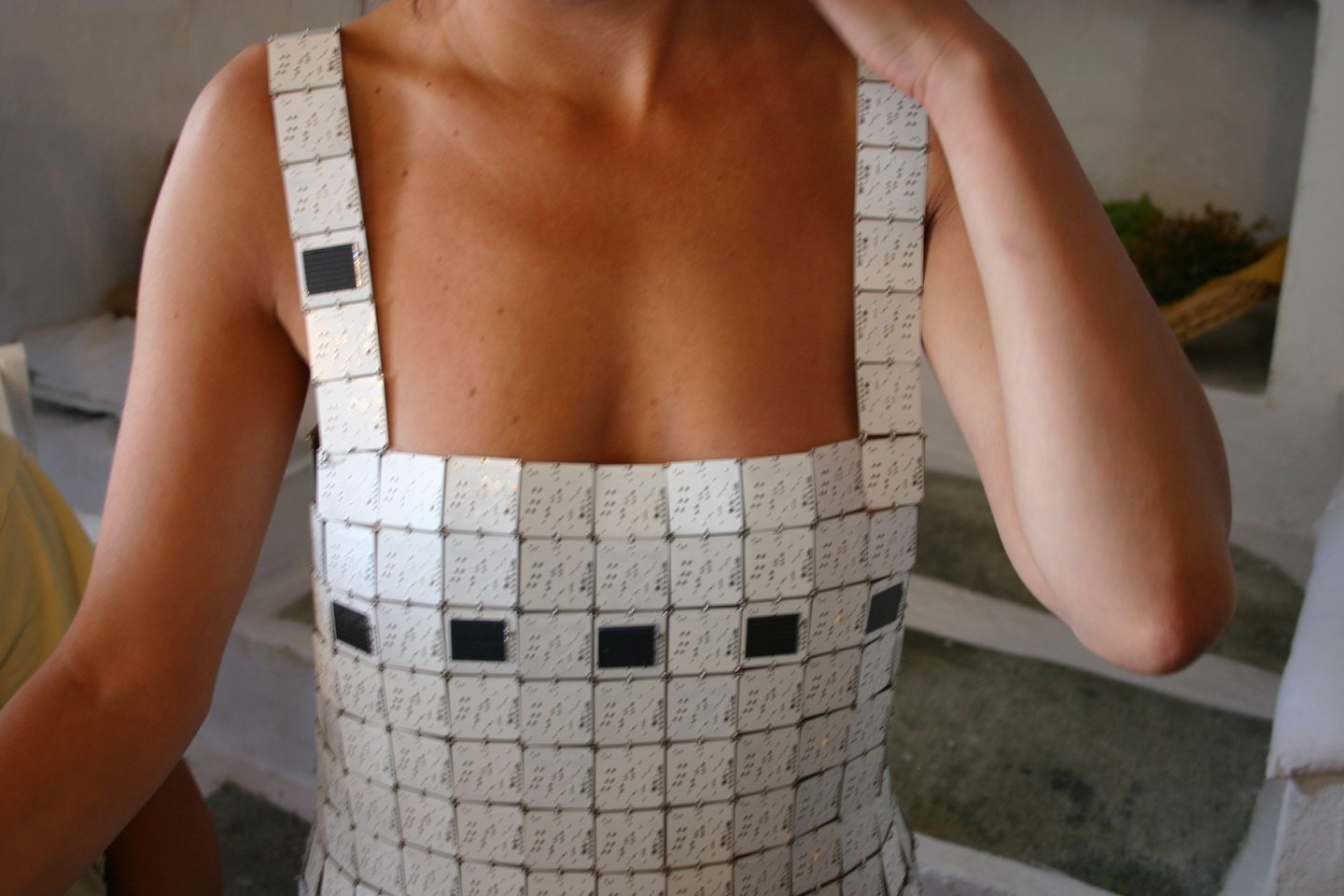
Each tile is designed to accommodate a solar cell, an RGB LED, or a photocell, along with jumper connectors in the form of 0-ohm resistors. A control board provides power, communicates with the tiles, and links to a computer via RF. The dress is completely modular, in both software and hardware.
Electronics not concealed, but worn as ornament.
Where the LoveJackets hid their circuitry in the seams, Day-for-Night turns the electronics outward and makes them the surface. The white circuit board — ordinarily the hidden substrate of a device — becomes the tile, the ornament, the unit of the garment. The homage to Paco Rabanne is exact: his 1966 dresses of linked metal and plastic discs treated clothing as an assembly of modular units rather than draped cloth, and Day-for-Night carries that logic into the circuit board in both function and form.
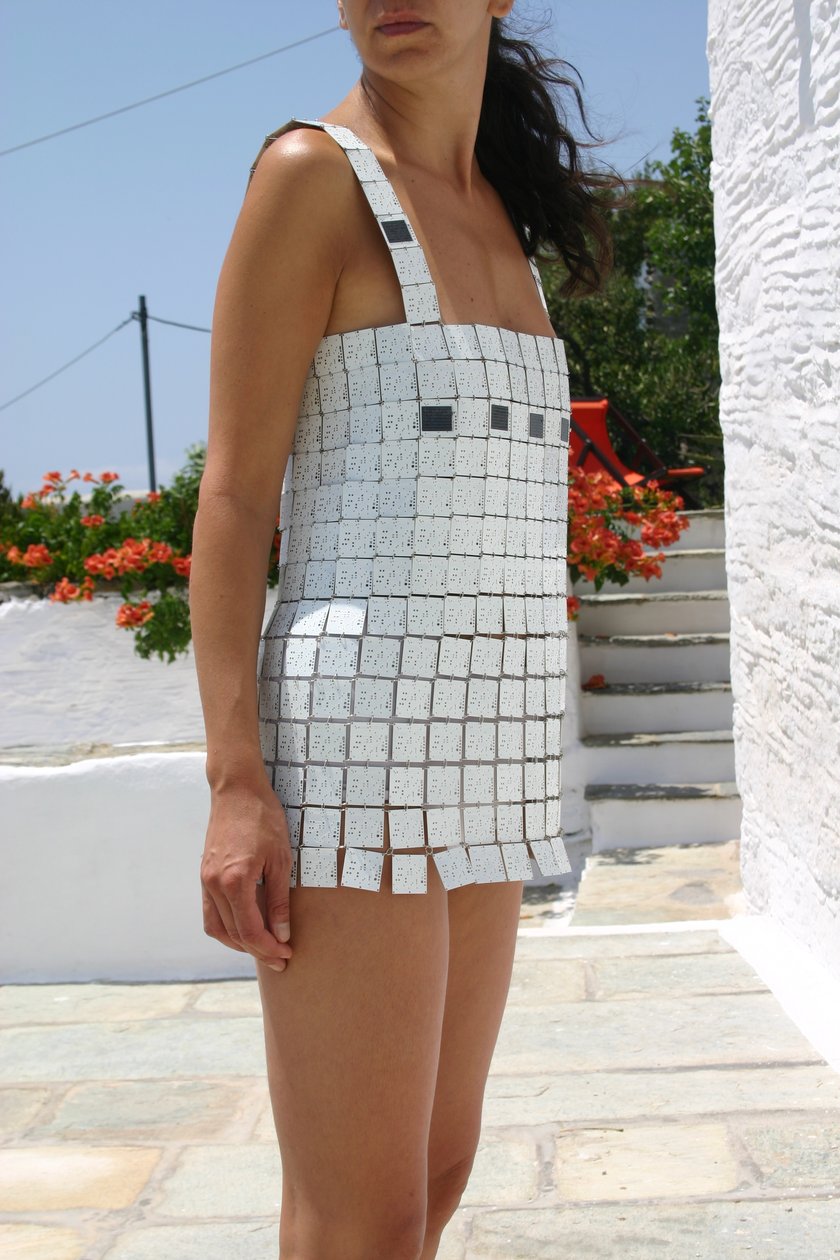
By day it takes light in; by night it gives it back.
Day-for-Night is less an object than a system. Its surface harvests light through solar cells, senses it through photocells, and returns it through LEDs. Two decades before e-textiles, energy-harvesting wearables, and modular, repairable hardware became fields of their own, Day-for-Night proposed the garment as a living, reconfigurable computational surface — modular down to the tile, in both hardware and software, and legible as a system rather than a product.
 ← All work