Material Encountersknowledge as translation between makers
Poirot: spatial intelligence model
Read ↗
Poirotspatial reasoning as model
Kolokotronis Archive
Read ↗
Kolokotronis Archivearchives as living topology
Living Systems
Read ↗
The Love Robotsautonomous relational behavior
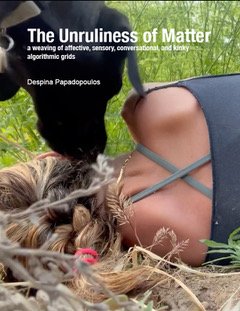
The Unruliness of Matter
Visit
The Unruliness of Matterpractice-led PhD, Royal College of Art
Installation view
Visit
Teaching
Why I Teach
"Thank you for teaching us to enjoy the uncertainty of life!"
So starts a thank you email from one of my undergraduate students that I never got to meet in person, as the entire class was conducted online in the middle of the COVID pandemic. I treasure this email and feel proud and honored that I was able to impart this message.
As an educator, I encourage my students to be keen observers, to think about the ideologies of the tools they use, to create their own tools when possible, and importantly, help them articulate who they are and who they want to be. Criticality, ultimately, coupled with care and intention, is what my teaching philosophy is.
Collaborative Arts ProgramTisch / NYU · 2023–2025
Visiting ProfessorPhilosophy, art theory, AI, and making methodologies.
School of Visual ArtsMFA Design for Social Innovation · 2012–2025
Founding FacultyCurriculum design; Mapping & Systems Design; Thesis Advisor.
Royal College of Art2019–2020
LecturerDialectics, entanglement, and the ethics of technology.
College for Creative StudiesDetroit · May 2018
Developed a 5-week curriculum: “AI and Ethics: How to Prepare Designers for the Age of Machine Learning Systems.”
Selected Writing
Oxford University Press2027 · Forthcoming
Material Encounters: Creativity in the Times of AI. With C. Moruzzi.
RoutledgeForthcoming
"AI as Philosophy Machine," AI and Algorithmic Aesthetics. With K. Walker.
CCAM, Yale2025
"Pattern Recognition: Between the Poetic and the Algorithmic," Machine as Medium.
ArteActa2025
"The Oracle of Delphi: Towards an Affective Promptology."
Animation Studies 2.0Mar 2024
"Animating Affect in the Algorithmic."
QuartzFeb 2018
"Trust is the New Empathy."
AdjacentFall 2017
"What I Learned from Dot," ITP & IMA Journal of Emerging Media.
CRC Press2015
"Future Scenarios: Ethical and Speculative Implications of Embodied Materialities," Wearable Computers and Augmented Reality.
AD Magazine2007
"Wearable Technologies, Portable Architectures and the Vicissitudes of the Space Between," John Wiley & Sons.
Personal and Ubiquitous Computing2001
"Interface Me: Pursuing Sociability through Personal Devices," Springer-Verlag, vol. 5, issue 3.
Selected Shows
World Beautiful Business ForumAthens · 2026
Love Robots.
Copeland GalleryLondon · 2023
Hopscotch. Research Biennial.
Dyson GalleryLondon · 2020
2084.
HolonIsrael · 2010–2011
Designing Machines. Catalogue.
Gwangju Design BiennaleKorea · 2005
Light into Life. Catalogue.
Victoria & Albert MuseumLondon · 2005
Touch Me.
Tufts University Art GalleryUS, traveling · 2005–2008
Pattern Language: Clothing as Communicator. Catalogue.
Eleni Koroneou GalleryAthens · 1995
Space Odyssey. Catalogue.
Material Systems · 1995
LoveJackets
In 1995 I made several pairs of jackets where each one emits and polls for a particular signal. Once the pair find each other, in a 10 feet distance radius, facing each other, the two start beeping in a call and response conversational tone, never at the same time, emitting a sound akin to crickets mating, and a pattern of LEDs blinks in unison to the sound.
Each jacket only responds to its unique pair. The technology used is basic: an infra-red receiver and transmitter, a PIC chip (Programmable Interrupt Controller; a precursor to Arduino) that controls the LEDs and speaker output and sends out the ‘bits’ of code that allow the pair to find each other. The components were as miniaturized and seamlessly integrated into the garment as possible but because of the material limitations of the time, hacked together with salvaged headphone wires for connecting the various components, and a lot of heat shrink-tubing, hot glue, electrical, paper, and duct tape. The LoveJackets, in their proto-technology simplicity and with their 9 Volt replaceable battery, amazingly, still work today.
The LoveJackets aimed to explore social interactional patterns and institute new ones.
While the LoveJackets aimed to explore social interactional patterns and institute new ones, they also elaborated on ways in which technology could seamlessly be integrated in garments to create a type of second skin, an interactive interface between the body and its exteriority, but also to explore new materials and their expressive potentialities. The aim of the LoveJackets was not to create ‘cyber’ garments but use technology in surprising, poetic, and innovative ways and place emphasis not on the technology but on its uses and how it could initiate serendipitous and unexpected encounters. Infra-red was used both to accentuate the possibility of communication through an invisible spectrum, making visible the invisible energy forces that surround being, and because of its inherent limitation: infra-red only works in ‘line-of-sight.’ The two wearers had to literally ‘see’ each other for the LoveJackets to be activated.
1995 was a time when technology was viewed with optimism, fascination and unbridled curiosity about what was to come, fascination with the potential for using technology to question notions of identity and belonging, the boundaries between human and non-human and approaching technology as a vehicle to overcome dualities and engage with new epistemological and ontological models, best exemplified in Haraway’s seminal Cyborg Manifesto, originally published in 1985 in the Socialist Review.
Embodied artifacts could function as philosophy machines.
The LoveJackets were indeed questioning such boundaries and potentialities but were also an exploration of how art practices could function as props and prompts to interrogate emerging relationships with technology, how embodied artifacts could function as philosophy machines, taking complex concepts and devising ways to manifest and circulate ideas into new and quotidian realms. When people wore them in galleries and museums where they were exhibited, they felt a child-like giddiness, playing games of hide and seek, coming close and turning around, developing spontaneous choreographies. There was something about the utter simplicity of this embodied idea that resonated with audiences.
The LoveJackets were inspired by Plato’s Symposium where Aristophanes discusses the original human nature as one of two parts fused in perfect union before Zeus deliberating with the other gods, in an attempt to humble human pride and make humans ‘weaker and more useful [to us] through the increase in their numbers’, cuts them in half. So the LoveJackets present that moment of delight and completeness where the two original halves find each other and exalt in their perfect union.
The LoveJackets felt at the time as the introduction of a type of ‘desiring technology.’ And indeed, the LoveJackets were an exploration of how desire and poetry can be part of technological systems, and therefore resist and subvert subordination to notions of efficiency and reductivism that thirty years later has come to dominate the uses of technology and human-machine relationships.
About
Despina Papadopoulos
I build systems that think through matter.
My work asks how intelligence, meaning, and connections emerge through bodies, materials, technologies, and institutions. Rather than treating design as the production of objects, I use it as a mode of philosophical inquiry: building wearable technologies, archives, performances, and computational systems that investigate how we come to know, behave, and engage with one another.
Over three decades I have worked across research labs, industry, universities, and cultural institutions — researching connected devices and wearable systems at Interval Research and NCR’s Knowledge Lab; leading information-experience design at IBM’s Innovation Center; as VP of Product Innovation at Empathic Technologies, directing a team across neuroscience, psychology, design, and machine learning to build affective and haptic technologies; and rebuilding a dispersed national archive as a living topology that resists its own closure. The work holds five patents, has been exhibited at the Victoria & Albert Museum, the Gwangju Design Biennale, and the Holon Design Museum, and grows from training in philosophy (Leuven), interaction design (NYU ITP), and a practice-led PhD at the Royal College of Art. While the contexts vary, the questions remain remarkably consistent: How do systems shape behaviour? What forms of intelligence do they privilege? How might they be designed differently?
Today my work focuses on embodied AI, material computation, and the ethics of intelligent systems — carrying two decades of teaching design and technology ethics at NYU and the RCA into current research. I am interested in forms of intelligence that emerge through interaction rather than abstraction, through material constraints rather than optimisation, and through care, ambiguity, and reciprocity rather than prediction alone.
Intelligence that emerges through care, ambiguity, and reciprocity — rather than prediction alone.
I am co-author, with Caterina Moruzzi, of Material Encounters: Creativity in the Times of AI (Oxford University Press, forthcoming).
Across research, teaching, and practice, I build what I think of as philosophy machines: systems that do not simply demonstrate ideas, but generate new ways of thinking.
Knowledge Systems · 2015
Mapping Bamiyan
In 2015 UNESCO asked me to map Bamiyan’s creative industries and develop a report with recommendations on how to turn the region into a creative hub — in a valley the world mostly remembers for what was destroyed there.
I didn’t do it from a desk. Over three weeks in-country I sat with the people who actually make Bamiyan’s culture — carpet weavers and calligraphers, radio journalists who had taught themselves the trade, a woman who could not read but ran a handicraft supply chain in her head, the founders of a film collective screening open-air cinema, the minister of Tourism and the regio's governor. Then twenty-two young activists, artists and entrepreneurs and I spent a day mapping their own city’s creative life — naming what it was, and what they hoped it would become.
We mapped every craft against its vitality: what was thriving — embroidery, weaving, photography, a women’s cycling team that had made the impossible look obvious — and what was sliding toward extinction — dance, theatre, pottery, the oral histories held only by the oldest generation. The map was never an inventory. It was a diagnosis of which kinds of knowledge were being carried forward, and which were quietly being let go.
A creative hub evolves. It is not made.
What I found was that Bamiyan’s identity lived in its patterns and the tenacity and resilience of its residents. The textiles and beadwork encoded stories, geographies, and lineages — a knowledge system most of the younger generation could no longer read.
So I designed a hub — not a building but a network with spokes: a community council that owned the thing from the outset, a shared identity, a maker space that would set a laser cutter beside a weaving loom, music training to revive an art that had nearly gone silent, radio to capture oral histories, and a long-term research program to catalogue the patterns and the stories inside them before they were lost. Against every reflex of development work, the governing principle was that the community had to drive it, or it would never take root. UNESCO’s role was not to build but to convene — to hold a vision, and then step back.
“We need a framework that connects the past to the future.”
I read this work now as the seed of almost everything that came after: the conviction that material culture is a form of knowledge that resists being digitized away, that archives are living and contested rather than settled, that technology is an enabler and never a savior, and that the most interesting systems are the ones you tend rather than engineer. Bamiyan taught me how to map a living thing without making assumptions and by observing patterns, gestures, aspirations and dreams.
When the Michael N. Stassinopoulos – VIOHALCO (MSVF) Public Benefit Foundation asked me to build a digital archive for Theodoros Kolokotronis — the most emblematic figure of the Greek Revolution — I refused the obvious brief. An archive is not a warehouse. It is a place.
One thousand one hundred and sixty-six documents, the earliest dated 1618, scattered for two centuries across heirs and institutions: the papers of the Revolution’s central figure had never been whole. My task was not to digitise a collection but to reconstitute a dispersed body of evidence as something that could be entered from many directions at once.
I took the theory seriously, and let it govern the build. Derrida reminds us in Mal d’Archive that the archive is both arché — a beginning — and command: it does not only keep the past, it authorises a reading of it. Foucault saw the archive as an epistemic apparatus; the archivist Eric Ketelaar as a dynamic space activated by everyone who touches it; Karen Barad would call its very formation intra-active. Taken together, the archive stops being a container and becomes a topological surface — at once ontological and epistemic — where materiality, identity, and meaning meet.
An archive is not a warehouse. It is a place.
So I named the project an Archive as Place — Archeiakós Tópos — and made the theory load-bearing. A topology has no fixed inside or outside; it is points that meet through many coordinates. I built the system so that no single reading is imposed and many paths are allowed: a person, a place, a date, a thread of “see also” are all equally legitimate ways in. I gave it a concept I had to coin — entaximotítes, the different modes of technical and social inclusion through which different users belong to the same archive differently.
And I made the architecture carry the argument. Open-source Omeka at the base — not because it was easiest, but because it was honest about what we were building: a system that belongs to its community and can connect outward. Dublin Core and APIs for interoperability. A semantic layer of names, places, and a glossary that explains in place, so you never leave the document to understand it. An IIIF viewer that keeps the materiality of each sheet — its wear, its time — beside the transcription. A design language drawn from the material itself: a parchment palette, serif for the historical text, sans-serif for the metadata. The place came to resemble what it holds.
The place came to resemble what it holds.
What holds me in this work is the argument the system makes. It is the clearest demonstration I have of a conviction that runs through everything I do — that material culture is a form of knowledge, that an archive is living and contested rather than settled, and that the most serious design decisions are philosophical ones translated into structure. An archive that is never complete, but always in becoming; and, finally, a place that does not belong to us, but within which we are continually reconstituted.
The HugJackets take the idea of the LoveJackets a step further. While the LoveJackets represent a random act of courtship, a chance encounter, the HugJackets demand a deliberate act of union. An embrace between the two wearers activates, like in the case of the LoveJackets, a pattern of LEDs and a heartbeat sound.
If the LoveJackets begin a courtship, the HugJackets consummate it.
An intricate appliqué made of conductive fabric is sewn on the front of each jacket. When two people wearing a HugJacket embrace they actually power each other up through that pattern. The symbolic energy transfer becomes fully actualized and the embrace is translated into a performance of light and sound. The HugJackets technology itself is astonishingly simple – it is the intricate patterning and placement of the conductive fabric that allows for the surprising connection and effect to take place.
The two jackets, through their twined pattern, literally plug into each other’s battery source. As in the case of the LoveJackets, the HugJackets are constructed in such a way as to provide innovative solutions in the mechanical integration of technological components, conductive fabric and traditional garment construction — while also prompting new, technologically-mediated interactions.
Material Systems · 2006
Day-for-Night
Day-for-Night — an homage to Paco Rabanne and a celebration of the beauty of electronics — is a modular, reconfigurable dress comprised of 448 white circuit boards, though the number changes, as the dress can grow longer or shorter.
Each tile is designed to accommodate a solar cell, an RGB LED, or a photocell, along with jumper connectors in the form of 0-ohm resistors. A control board provides power, communicates with the tiles, and links to a computer via RF. The dress is completely modular, in both software and hardware.
Electronics not concealed, but worn as ornament.
Where the LoveJackets hid their circuitry in the seams, Day-for-Night turns the electronics outward and makes them the surface. The white circuit board — ordinarily the hidden substrate of a device — becomes the tile, the ornament, the unit of the garment. The homage to Paco Rabanne is exact: his 1966 dresses of linked metal and plastic discs treated clothing as an assembly of modular units rather than draped cloth, and Day-for-Night carries that logic into the circuit board in both function and form.
By day it takes light in; by night it gives it back.
Day-for-Night is less an object than a system. Its surface harvests light through solar cells, senses it through photocells, and returns it through LEDs. Two decades before e-textiles, energy-harvesting wearables, and modular, repairable hardware became fields of their own, Day-for-Night proposed the garment as a living, reconfigurable computational surface — modular down to the tile, in both hardware and software, and legible as a system rather than a product.
Material Encounters: Creativity in the Times of AI is a book I am writing with the philosopher Caterina Moruzzi, under contract with Oxford University Press. It asks how creativity is conceived, practiced, and mediated through the technologies of making — from the hand in the clay to the model in the machine.
The wager of the book is that creativity is not a property of minds but an emergent, relational process between minds, materials, and machines. To test it, we did not only write — we convened. Over two days in Athens, Caterina and I brought together nine makers with deep material expertise — ceramicists, weavers, architects, digital artists, coders — and asked them to work through, and with, the question of how creativity is made.
The structure was deliberate. We began by mapping the book’s concepts — technē, intentionality, process, desire, materiality — onto each maker’s own practice. Then each showed us the moments when a material resists, surprises, or guides them: the tacit knowledge of learning to read a material’s affordances and its limits. On the second day we forced an exchange — a ceramicist wrote code, a digital artist worked clay, a weaver explored algorithmic pattern — to defamiliarise skill and surface everyone’s assumptions about control and creative agency. We were working in the lineage of Jane Bennett’s vibrant matter and Karen Barad’s insistence that matter matters, listening for what Adorno would call constellations of meaning.
AI receded to the background — just another technology of making.
Something unexpected happened. We had planned for AI to be central; over two days it receded and became just another technology of making — even as we all knew it is claiming a larger piece of the equation. We were surrounded by Jacquard looms from the 1800s and still-operating machines enmeshed with their operators, unable to run without their idiosyncrasies — their quirks, and maybe their quarks — being tended. What bonded the room was not technology but desire: the wish to share the delight, and the pain, of the creative process with peers who were there out of love for what they do.
I have spent this year thinking about love and about creativity, and it was a double-take to realise how much the two share — desire, care, tending, listening, giving time, memory, narrative. That is what the book is building toward: that creativity, like love, is a relational and material process that cannot be reduced to efficiency or output, and that AI enters this field not as its author but as one more technology through which technē makes us as we make it.
Technē makes us, as we make technē.
The workshop — The Making of Creativity — was supported by the Edinburgh College of Art RKEI Fund, BRAID UK, the AHRC, the Onassis Foundation, and Doric Shipbrokers S.A., and hosted at the NHMA / Benaki Museum in Athens; participants were invited to join the “Creativity, AI, and the Human” cluster at the Edinburgh Futures Institute. Full documentation, with experimental documentation by Kevin Walker, lives at the-making-of-creativity.com.
The Love Robots are built on notions of love, not ‘intelligence,’ automation, or practicality. They use sound, motion and animation, and they try to find each other.
Sometimes they succeed, often they do not.
They are fragile and vulnerable, made from materials such as glass and stone. We built the Love Robots as props or prompts to help people to think about love.
The most interesting behaviors of the Love Robots are due to their materiality. Their motors exhibit spontaneous synchronization through mechanical coupling (Huygens synchronization) as they become part of an active matter system. Their cable-tie legs scratch each surface differently, sliding, gliding or getting slightly stuck. Wires bend outwards from each robot. Our first impulse was to shorten them, until we saw how they act like elbows nudging each other. They wobble, they flow, they tangle, and get into a type of entrainment.
The Love Robots were launched at the World Beautiful Business Forum in Athens in May 2026, and will be part of Mozilla Festival in Barcelona, Spain, 28–30 October 2026. More at philosophymachines.com/loverobots.
Research With Industry · 2023
Lubrizol
Lubrizol asked me to review their extensive materials portfolio and find applications for flexible electronics and wearables.
In what became a multi-tiered engagement, I ran a series of exploratory activities, met with every department head, held innovation workshops, and mapped Lubrizol’s offerings. I then proposed a set of applications built exclusively from materials Lubrizol had developed — and settled on the award-winning Multi-Tech Commuter Heated Jacket.
From pattern design to sourcing fabrics across two continents, and bringing partners together for the printed electronics and a custom connector, I materialized the project in nine months, and under budget.
Wearable electronics demand systems thinking — design, materials, and the value chain at once.
The project underscores why novel wearable electronics require systems thinking: design, materials science, applications know-how, and value-chain partners, held together at once. It takes the right mindset and capabilities to turn an idea into a prototype and then a commercial reality quickly. The jacket is now the main showpiece at trade shows — and stands, proudly, outside the CEO’s office.
Research With Industry · 2018
Nivea
Nivea's biophysicists and chemists brought me a problem most people would call impossible: a t-shirt that reads sweat with laboratory precision, survives the wash, comes in every size, and rolls off the line by the thousand.
A laboratory instrument you can throw in the wash.
A precision sensor and a mass-produced garment want opposite things — one demands exactness, the other forgives nothing. So I rebuilt the shirt from the pattern up: a new construction that made it manufacturable, a high-precision alloy pressed into service as the sensing element, a circuit redrawn for comfort against the skin, and a manufacturing road-map with partners I trusted to hold the tolerances. Five thousand shirts came off the line.
The shirt let Nivea run comprehensive field tests and gather data that proved valuable across every tier of the organisation, making science backed marketing claims, while bringing siloed departments to work together — documented in the article “How Technology Generates Positive Ripple Effects for Nivea.”
Research With Industry · 2018
Ralph Lauren
As the official outfitter of the USA Olympic team, Ralph Lauren wanted to push innovation for the 2018 Winter Olympics: a heated parka built on conductive inks developed by DuPont.
The hard problem sat between the giants. Siloed manufacturing processes and domain expertise made it difficult to develop the connector that had to bridge the ink and the electronics — the small part on which the whole technical function depended.
Bridging two giants of industry — Ralph Lauren and DuPont.
I designed, tested, and sourced the connectors, and delivered — on time — a solution that was easy to implement and slotted cleanly into existing supply chains. I’m proud to have been part of such an iconic moment, bridging two giants of industry. The making of the parka is documented in the article “Bringing On the Heat.”
Material Systems · Empathic Technologies · 2022
Haptic Device
What is the connection between mind and body — between interoception and flow? What does the future of haptics hold? These were the open-ended questions of a research brief in which I was asked to develop concepts bringing together neuroscience, psychology, and design.
Embodied concepts have to be tested on the body.
Holding firmly that embodied concepts have to be tested on the body, I built a series of fully functional prototypes, ran extensive user testing, and developed a novel haptic device — controlled by both a mobile phone and Apple Watch, a great way to tap and leverage contextual data. I paired deep research with embodied probes and drew rich feedback from users. Forms were sculpted directly on the body, organic shapes that only later became CAD models and 3D prints. I evaluated a large field of actuators and designed drivers to produce nuanced effects.
The process was modular and agile — conceptually, and in every design decision. Across more than fifty user-testing sessions I gathered a dataset rich enough to inform a machine-learning model. A dream project with a dream team: research and real data delivered, and robust hardware and software built, in a dizzying seven months.
Research With Industry · NCR Knowledge Lab · 2000
mbracelet
How might a wearable computer become an interface between people, rather than between a person and a machine?
This question motivated the design of mbracelet, a wearable computing prototype developed for NCR’s Knowledge Lab at a time when wearable technologies were still largely imagined as miniature computers attached to the body. Rather than treating the wearable as a more efficient personal device, mbracelet proposed a different role for technology. It explored how computation could facilitate social interaction, creating opportunities for encounter, exchange, and shared experience instead of simply delivering information to an individual user.
The project emerged from the observation that personal technologies increasingly mediate everyday relationships. As mobile devices moved from desktops into pockets, bags, and onto bodies, they were no longer simply tools — they became participants in how people communicate, perform identity, and inhabit social space. Designing these technologies therefore required thinking beyond usability and functionality towards the ways they shape human relationships.
Technology should not become more personal. It should become more social.
This led to the concept of social functionality: the idea that digital devices should not only support interaction between people and machines, but actively enable interaction between people. Technology becomes meaningful not when it demands attention, but when it creates conditions for conversation, collaboration, play, and serendipitous encounters.
Rather than beginning with available technologies, the project began by studying existing social behaviours. Working with teenage users, I examined how friendships were formed and maintained through the exchange of objects, gestures, messages, and rituals of belonging. These observations became the foundation for the design itself.
The resulting wearable functioned as a modular digital platform. Interchangeable components let users customise what they carried, while physical exchanges between wearers enabled information to be shared through embodied gestures rather than invisible wireless transactions. A cross-handshake interaction transformed the familiar act of greeting into a means of exchanging digital messages, collapsing the distinction between physical and virtual communication. Programmable light patterns let users express identity dynamically through movement, turning the device into an evolving medium of self-expression rather than a static object of personalisation.
Equally important was the material design of the wearable itself. Flexible circuitry, waterproof polyurethane, conductive fastenings, and modular architecture were developed to make computation feel inseparable from the experience of wearing jewellery or clothing. The interface was designed to disappear into everyday life, allowing social interaction — not technology — to remain at the centre of attention.
Interfaces that communicate through touch rather than screens; digital systems that support intimacy rather than efficiency.
Looking back, mbracelet represents the beginning of an ongoing investigation that continues throughout my practice. Many of the questions first explored here reappear in later projects, including LoveJackets, Vambrace Conversations, and all my work in The Unruliness of Matter: how interfaces can communicate through touch rather than screens; how digital systems can support intimacy rather than efficiency; how materials themselves can become conversational; and how technology might strengthen human relationships instead of replacing them.
Although developed long before today’s conversations around embodied AI, affective computing, and wearable intelligence, mbracelet proposed a simple proposition that continues to guide my work: technology should not become more personal. It should become more social.
Knowledge Systems · with Kevin Walker · 2026
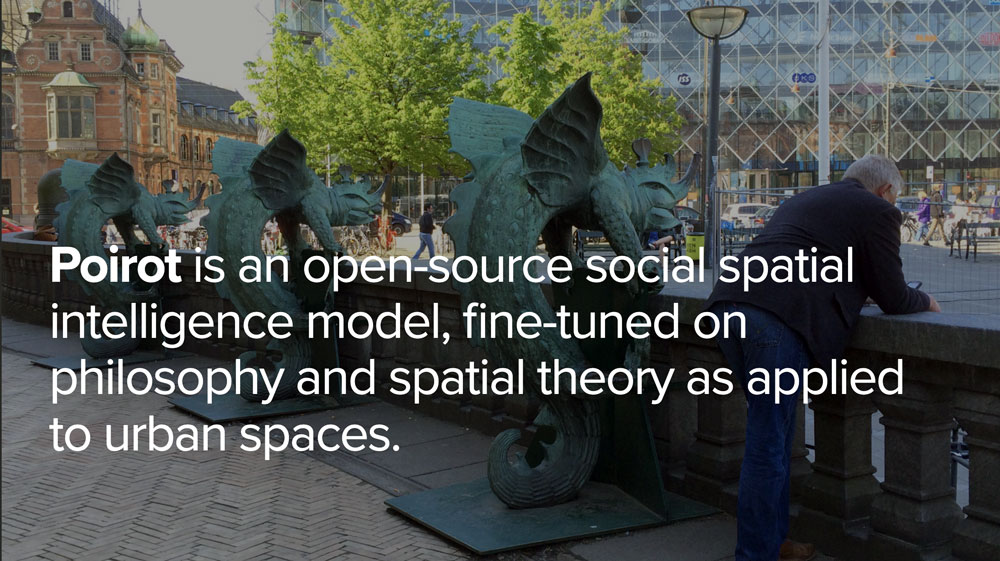
Poirot
Current spatial intelligence in AI is built to see the world as physics — geometry, movement, task performance. Poirot asks what it would take to see it as a social scene instead.
Poirot is a machine learning system I built with Kevin Walker at Philosophy Machines to test a proposition: that spatial intelligence in machines has, so far, been trained on the wrong things. Autonomous vehicles, robotics, visual question answering — these systems are grounded in physics. What they miss is what an ethnographer or philosopher sees looking at the same street: the power relations naturalised in a bench, the exclusions coded into a plaza, the histories layered in a facade. In the language of our paper, these are the “occluded features” of a spatial scene — features every human sees, and no current spatial AI does.
The occluded features of a scene are cultural and philosophical.
To test the idea, we combined two models — a vision-language model to read the image, and a smaller language model fine-tuned on relevant theory from philosophy, anthropology, and critical spatial practices (Lefebvre, de Certeau, Rendell). We named it Poirot, after Agatha Christie’s detective, who builds coherent interpretations from fragmentary data. Then we compared Poirot’s readings of six urban scenes — the Barbican at dusk, a rollerblading crowd at Bastille, an Indigenous rights ceremony in Guadalajara, a café in Athens, Shibuya at night, a canal in Amsterdam — against those of seven human experts, and against ChatGPT and Claude.
The results were both humbling and clarifying. Generalised commercial LLMs proved better at grounded argument — connecting specific design choices to specific effects. Human respondents showed how critique actually emerges: from embodied experience, from the immediate reading of a scene (“you are being watched”; “it’s not warm enough”), before it is ever theorised. Poirot, trained largely on the language of critical theory, learned how critical theory sounds more than how it works: it named frameworks, linked analysis to action, stated political commitments — but often floated free of the specific image in front of it.
Then something we did not expect. Because we fine-tuned Poirot with several LoRA adapters trained on different theoretical corpora, it returned not one interpretation of each scene but several — and it often answered a question with a question. In a field engineered to project a single authoritative voice, Poirot spoke in the plural. That, unexpectedly, is close to what critical spatial theory itself demands: a refusal to totalise, an insistence that any place holds more than one legitimate reading.
Poirot spoke in the plural.
We take this as a small first test of a larger conviction: that machine learning systems built out of the social sciences and humanities — not only trained on them, but designed by their logics — behave differently, and sometimes better, than systems built by engineering alone. Poirot is a first sketch. It is one thread of an ongoing investigation into how the humanities can shape AI, and not merely critique it.